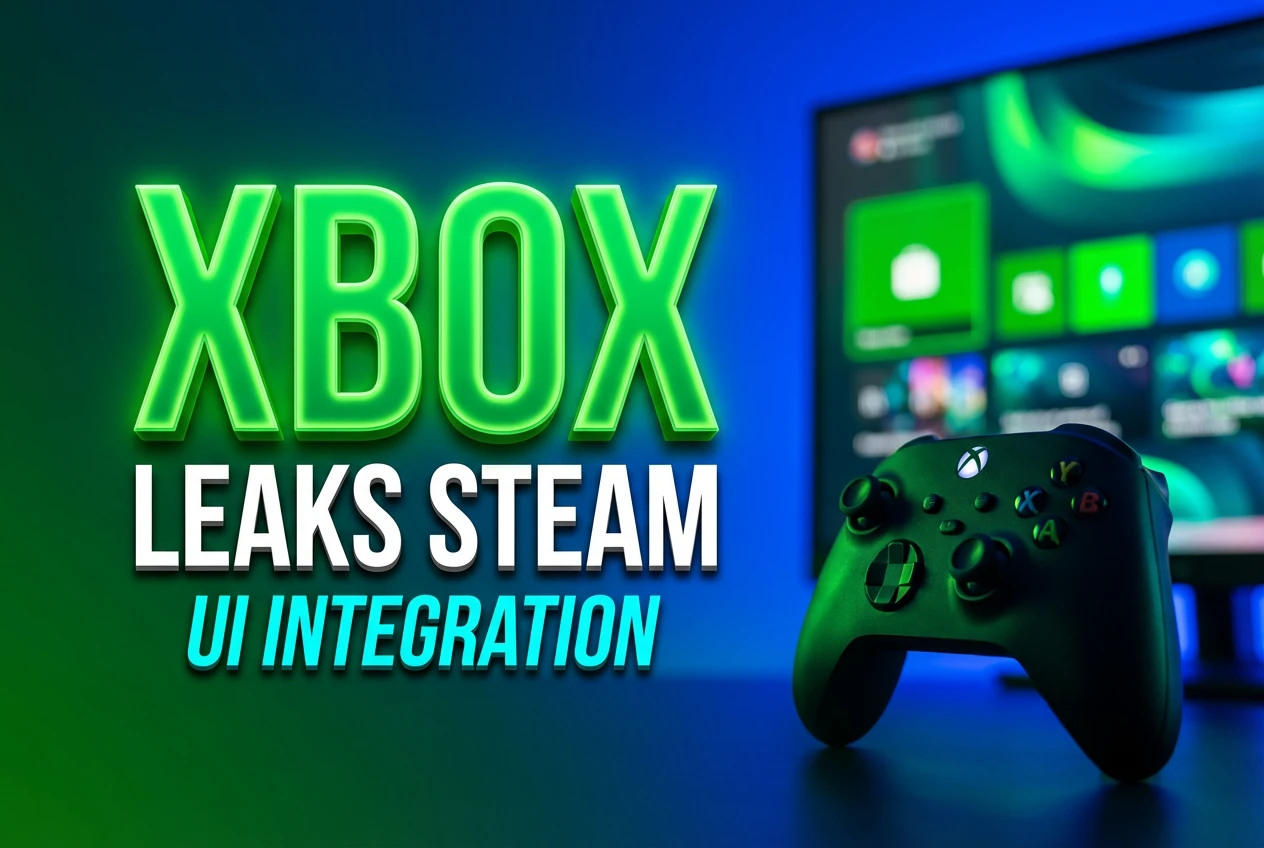
On March 20, 2025, Microsoft published a routine Game Developers Conference blog post that accidentally revealed its unannounced software roadmap for portable gaming. The post featured an image of a unified interface running across multiple screens, but eagle-eyed readers quickly spotted one specific detail. Right next to the standard game library filters sat a dedicated tab for Steam. The company pulled the image offline shortly after journalists began asking questions.
The GDC Blog Post That Disappeared
The deleted image was originally part of a developer-focused update titled “Opening a Billion Doors with Xbox.” This mockup showcased a completely overhauled digital library running seamlessly across a television, a tablet, and what appeared to be an ASUS ROG Ally. The most important revelation was a dedicated tab for a Steam library resting alongside typical Xbox store categories.
Microsoft rapidly deleted the image once media outlets like The Verge reached out for comment on the integration. Despite the swift removal, the internet had already archived the screenshots, confirming what many players have suspected for months. The company is actively building a universal launcher that detects games from rival storefronts and displays them in one centralized location.
This software pivot represents a major shift away from closed ecosystems. Instead of forcing players to navigate the clumsy standard desktop environment to open different game clients, the new dashboard acts as a universal front end. If the update rolls out as depicted, users will soon boot up their devices and see their Epic Games Store titles resting right next to their active Game Pass subscriptions.
This product hints at how the Xbox software platform will evolve going forward, and how it will connect all kinds of devices together at a single point.
Microsoft Gaming CEO Phil Spencer shared that perspective in a recent interview with Famitsu while discussing how third-party hardware influences their software strategy. The executive team seems fully aware that modern players rarely buy games from just one digital storefront. Acknowledging that reality by bringing outside catalogs into the native Xbox application is a bold concession that prioritizes user convenience over strict platform lock-in.
Windows 11 Prepares for a Handheld Future
Behind the scenes, preview builds of Windows 11 are already testing a new interface mode designed entirely for small touchscreens. On April 2, 2025, testers on the Dev and Beta channels discovered a feature called “Gaming Posture” hidden in the operating system’s settings. This new toggle allows devices to boot directly into a handheld-friendly interface, bypassing the traditional desktop altogether.
Navigating standard Windows on a seven-inch display has always been a frustrating experience. The success of Valve’s Steam Deck, which uses a custom Linux-based operating system called SteamOS, applied significant pressure on Microsoft to rethink its approach to portable hardware. To remain competitive, the engineering team knew they had to build something better than the limited “Compact Mode” they released for the Xbox Game Bar in early 2024.
The financial stakes behind this interface overhaul are substantial. As the traditional console market matures, portable and hybrid devices are capturing a larger share of consumer spending.
| Market Metric (2024 Data) | Financial Impact |
|---|---|
| Global Handheld Market Size | $16.3 billion |
| Hybrid System Revenue | $12.8 billion |
| Adult User Segment (Ages 18-35) | $8.7 billion |
| Projected Industry Growth (CAGR) | 8.8% through 2034 |
According to an analysis of the global handheld gaming market, hybrid hardware like the Nintendo Switch and various portable PCs generated $12.8 billion in hybrid system revenue last year. These devices accounted for over forty percent of all global demand in the sector. Microsoft recognizes that capturing this demographic requires an operating system that feels like a dedicated console rather than a compromised desktop computer.
To support this growing category of hardware, developers need better tools to make their software run smoothly across different form factors. Reports indicate Microsoft is building exactly that, with a few key initiatives expected to roll out over the coming year.
- New display scaling options designed specifically for small eight-inch panels
- Improved touch target sizes for core Windows navigation menus
- Automatic detection of connected controller hardware upon system boot
- Better battery management profiles tailored for intensive local rendering
Building Hardware for Local Play
Software changes are just the groundwork for a rumored first-party portable device codenamed Project Keenan. Industry reports suggest Microsoft is actively collaborating with ASUS to bring an officially branded handheld to market. By partnering with an established hardware manufacturer, the company can avoid the costly trial-and-error phase of designing portable cooling systems and ergonomic chassis designs from scratch.
This hardware strategy has been quietly evolving for several years. During the FTC v. Microsoft trial in September 2023, leaked court documents revealed internal strategy presentations from 2022. At the time, executives were pitching a sub-$99 hybrid cloud handheld that relied heavily on remote streaming rather than onboard processing. However, consumer preferences have shifted significantly since those documents were drafted.
Players have repeatedly shown a preference for devices that can run software natively without depending on a perfect internet connection. Phil Spencer directly addressed this shift during an IGN Live interview in June 2024. When pressed on the rumors of upcoming hardware, he noted that local playback is essential for any modern portable device.
If Project Keenan arrives later this year, it will face intense competition. The portable PC space is currently dominated by established players like Valve and Lenovo. But a device bearing the official Xbox brand – backed by a customized version of Windows that natively organizes a player’s Steam and Epic catalogs – could easily disrupt the current market hierarchy.
Bridging the PC and Console Gap
Microsoft wants its gaming ecosystem to exist anywhere a screen does, not just beneath a television in the living room. Late last year, the marketing department launched a widespread “This is an Xbox” campaign. The advertisements featured everything from mobile phones to smart TVs, driving home the message that the platform is now a digital service rather than a specific physical box.
Making that vision a reality requires a unified technical foundation. Internal teams are currently working on Project Rainway cross-platform APIs, which aim to standardize the user interface across all available devices. These background tools ensure that whether a player logs in on a desktop computer, a tablet, or a console, the store layout, achievement tracking, and social features feel identical.
To complete this transition, the company is preparing several backend updates designed to merge the disparate halves of its audience.
- Synchronized friend lists spanning both PC and traditional console networks
- Shared cloud save data that updates instantly between desktop and portable devices
- Unified achievement tracking that recognizes progress regardless of the launcher used
Despite this heavy focus on platform-agnostic software, traditional hardware development has not stopped. Xbox President Sarah Bond recently told listeners on the official company podcast that the engineering team is focused on delivering the largest technical leap you will have ever seen in a hardware generation. That next-generation roadmap is currently slated for 2028, but the software foundation supporting it is already being deployed.
The lines separating these platforms are fading rapidly, and this leaked #XboxUI proves Microsoft knows exactly where the industry is heading. As the company prepares for its next hardware generation, the future of #HandheldGaming looks less about which plastic box you buy, and more about taking your entire combined library wherever you choose to go.