For decades, community hospitals have been swallowed by sprawling corporate networks. If a local facility wants to keep its doors open, the traditional playbook says it needs a wealthy buyer. Jupiter Medical Center in Florida completely ignored that script. Instead of selling out, the non-profit institution wrote a huge check to build a state-of-the-art facility, dedicating a specific portion of that directly to robotic surgery.
The strategy is a bold rejection of industry norms. Independent hospitals across the country struggle to stay afloat amid soaring operational costs and intense local competition. Yet this standalone facility has doubled down on strategic, high-cost investments. When a local facility faces financial pressure, the easy way out is to sign a contract with a national health network. By focusing intensely on high-tech patient care, the hospital created a blueprint for operational survival.
The Outlier in Palm Beach County
Only 19% of hospitals in the U.S. remain unaffiliated with larger health systems as of December 2024. That number keeps dropping every year as operational costs skyrocket and insurance reimbursements shrink. In South Florida, the landscape is heavily dominated by multi-billion dollar titans like HCA Healthcare, Baptist Health South Florida, and Cleveland Clinic Florida. These corporate giants have vast resources to absorb smaller competitors.
Jupiter Medical Center sits squarely in the middle of this competitive zone as the only independent, non-profit regional medical center left in Palm Beach and Martin counties. Their survival strategy leans heavily on a philanthropic foundation model. This unique financial structure relies on wealthy local donors to fund capital improvements, allowing the hospital to reinvest its profits into technology rather than paying out corporate shareholders.
When Dr. Amit Rastogi took over as President and CEO in September 2019, he leaned hard into a high-tech independence strategy. The hospital recognized that to stop patients from driving to larger city hubs for specialized care, they needed equipment that matched or beat what the corporate giants were using. They opened the Anderson Family Cancer Institute in May 2020 as a first major step. That realization eventually sparked the largest expansion in the hospital’s 45-year history.
Inside the 90,000 Square Foot Upgrade
In January 2024, the hospital officially opened the doors to the Johnny and Terry Gray Surgical Institute. The $100 million building project completely transformed their clinical capabilities. The facility spans an impressive 90,000 square feet and features 16 smart operating rooms explicitly designed for advanced procedures.
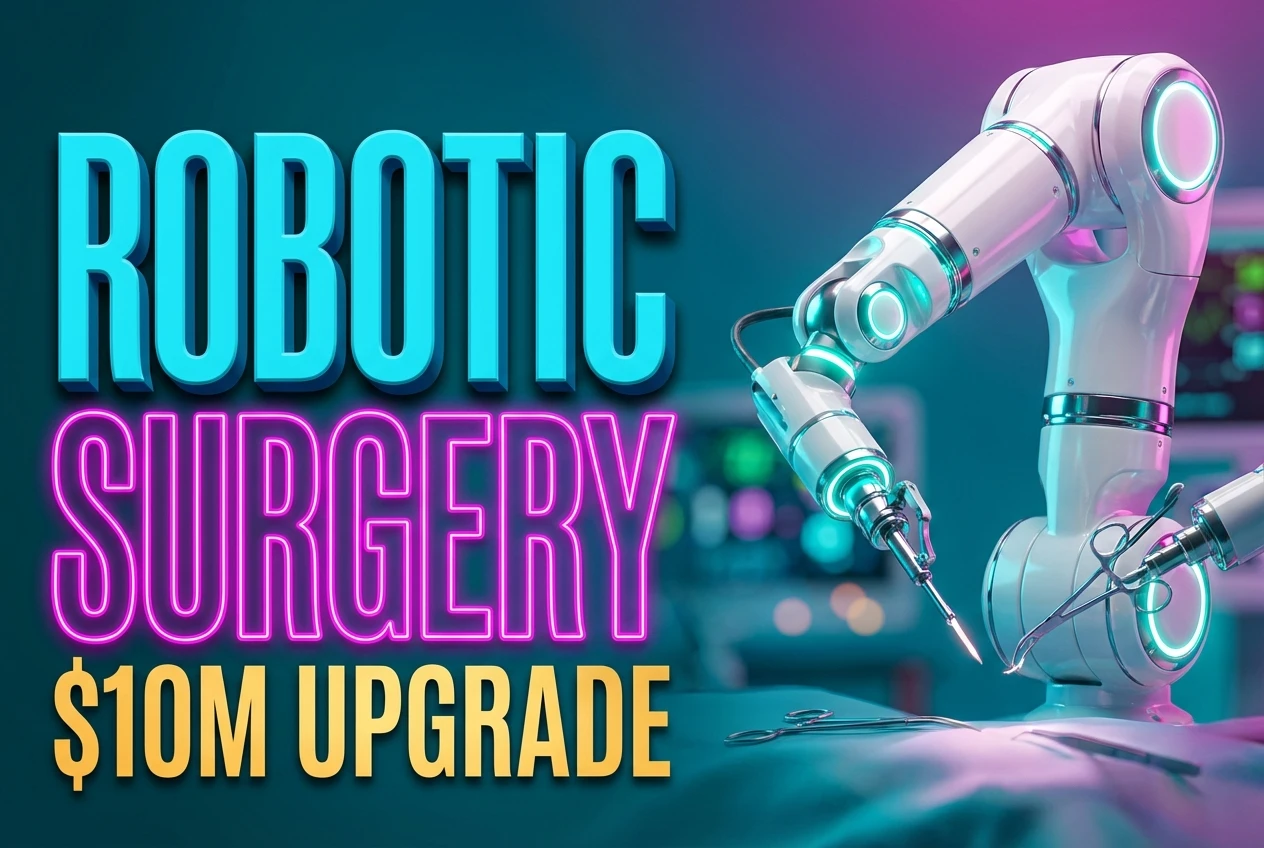
The dedicated $10 million robotics suite was fully integrated by February 2024. This hardware upgrade gives surgical teams access to tools that were once exclusive to giant research universities. The complete collection of advanced surgical hardware now includes:
- Six da Vinci Xi systems for minimally invasive general procedures
- Three Mako SmartRobotics units designed specifically for complex orthopedic work
- The Ion endoluminal system used for precise lung biopsies
- Two hybrid operating suites that allow surgeons to switch techniques seamlessly
This expansion was not just a luxury upgrade. Demand for elective surgeries had surged over the previous 24 months, leading to a 25% increase in robotic-assisted surgery volume at the facility. Wait times were getting longer, and the new institute provided the necessary capacity to handle the influx of patients.
| Surgical Hardware Platform | Primary Clinical Application |
|---|---|
| da Vinci Xi Surgical System | Minimally invasive general procedures |
| Mako SmartRobotics | Precision orthopedic joint surgery |
| Ion Endoluminal System | Advanced robotic lung biopsies |
| CyberKnife M6 System | Non-invasive tumor treatment |
Trimming Days Off the Recovery Room
The hospital recently celebrated its 10,000th robotic surgery, but the real victory lies in the patient data. Advanced machines do not just look impressive in a promotional brochure. They directly change how long a patient suffers after a major operation.
For example, the team recently completed a robotic minimally invasive direct coronary artery bypass surgery. A traditional approach to this specific heart procedure requires opening the sternum entirely. That older method guarantees extended hospital stays and intense pain during rehabilitation.
Dr. Rogerio C. Lilenbaum, the Chief Physician Executive at the facility, noted that these advanced systems provide unparalleled visualization. Surgeons can see the surgical field in high-definition 3D, allowing them to manipulate tissues with robotic arms that rotate far beyond the limits of a human wrist. The robotic approach provides several direct patient benefits:
- Shorter mandatory hospital stays
- Significantly less blood loss during operation
- Lower overall risk of post-op complications
- Faster return to normal daily activities
According to data from the Journal of Robotic Surgery published in 2023, robotic-assisted techniques reduce the average hospital stay by 1.5 days for urological and gynecological cases. This faster turnaround frees up beds and gets people back to their normal lives sooner. These clear advantages are driving patients to travel from major medical hubs like Boston just to seek care in Florida.
Our independence is a core value that allows us to be agile and patient-centered. By investing in the highest level of technology, we ensure our community doesn’t have to leave the area for world-class care.
This quote from Dr. Rastogi highlights exactly why the local administration refuses to entertain buyout offers. They believe patient care degrades when decisions are routed through a distant corporate headquarters.
The Strategic Cost of Staying Solo
A $10 million hardware investment requires constant financial justification. Independence in the healthcare sector requires constant reinvestment, and a hospital cannot simply buy expensive machines once and expect to coast for a decade. The global market size for robotic surgery systems is projected to hit $11.2 billion by 2027, meaning the technology will only grow more advanced and more expensive.
Jupiter Medical Center avoids the bureaucratic delays that plague larger health networks when purchasing this new gear. If their surgeons identify a tool that will improve outcomes, the leadership team can approve the acquisition quickly. There are no competing interests pulling the administration in different directions.
Nationwide, over 100 hospital merger deals occur annually. These consolidations often lead to standardized care protocols dictated by a central office rather than local physicians. By remaining independent, Jupiter Medical Center sidesteps this corporatization of medicine. They can tailor their equipment purchases directly to the specific health demographics of South Florida, prioritizing treatments that their community actually needs.
The American Hospital Association noted in a 2022 report that independent hospitals investing in specialized high-margin services like robotic surgery are 30% more likely to resist acquisition by larger networks.
The $10 million investment serves as both a clinical upgrade and a defense mechanism against corporate consolidation.
Expanding the High-Tech Footprint
The facility plans to expand its robotic offerings into more oncology and thoracic procedures throughout the coming years. They are also actively integrating artificial intelligence into their existing systems to enhance precision even further. By keeping the focus on direct community impact rather than corporate shareholder returns, the hospital secures its own future.
Part of this future involves recruiting top-tier surgeons to strengthen the facility’s reputation as a premier medical destination. For local residents, this strategy means better care closer to home. Complex surgeries that once required a flight to a different state can now be handled in a community setting.
When a local facility invests heavily in its own capabilities, the surrounding community reaps the rewards. This aggressive approach ensures the future of #Healthcare remains focused on local needs rather than distant corporate #HospitalMergers dictated by a balance sheet. The technology might be expensive, but the ability to remain independent and patient-focused is clearly worth the price tag.