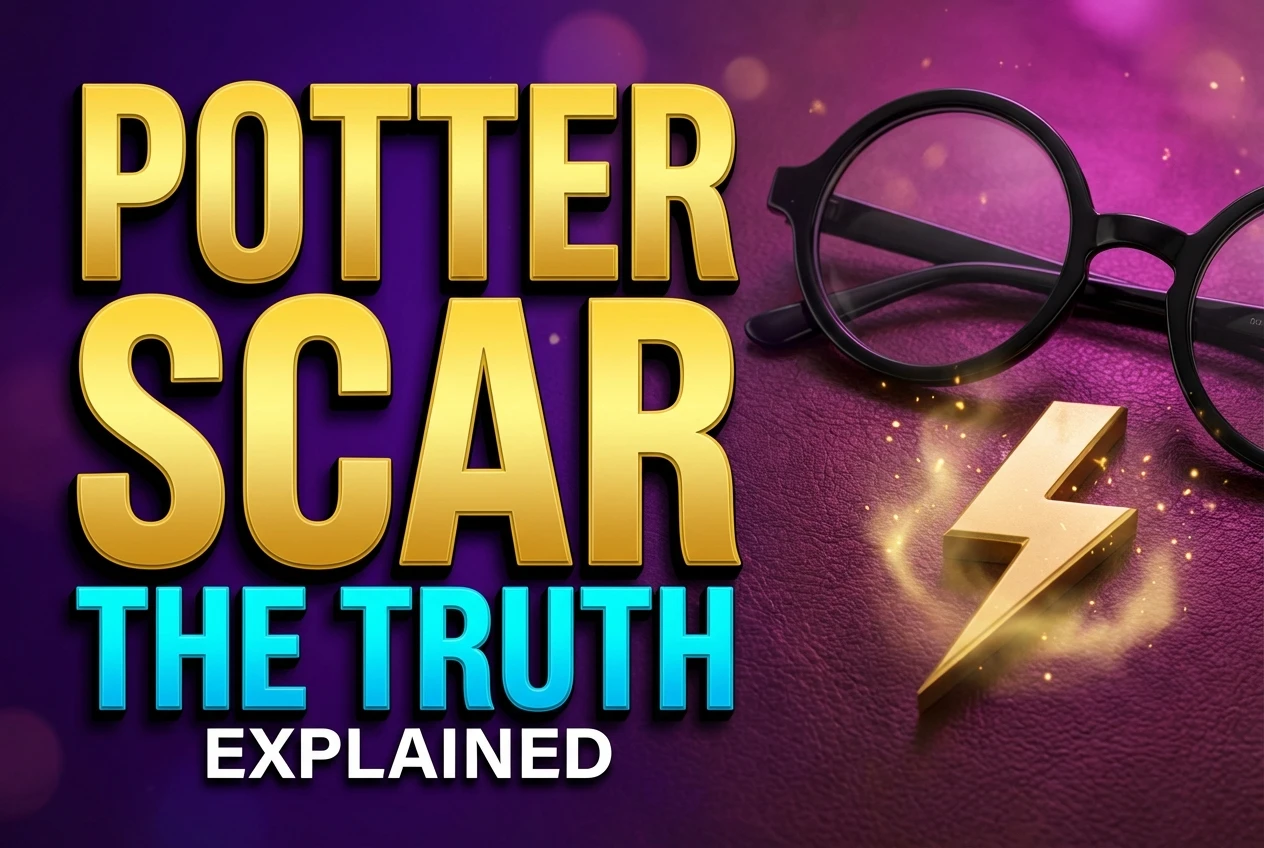
You know the shape. It is arguably the most recognizable facial feature in modern pop culture, right up there with the round glasses and the Gryffindor scarf. For decades, readers assumed the jagged line on the boy wizard’s forehead was just a stylistic representation of a backfired curse. But a persistent realization keeps surfacing across social media, suggesting the famous mark is actually an exact blueprint of the spell that failed to kill him.
A Wand Movement Hiding in Plain Sight
The official Harry Potter Wiki and various licensed guidebooks have shown the diagram for years. To cast the Avada Kedavra curse, a wizard must sweep their wand in a sharp, downward zigzag. This exact wand movement mirrors the scar left on baby Harry’s forehead after Lord Voldemort attacked him.
It makes logical sense within the rules of the universe. The deadly spell, which is usually depicted as a blinding flash of green light, requires a very specific physical motion to execute properly. When the curse rebounded off Lily Potter’s sacrificial protection, the physical energy of that wand motion essentially burned its path directly into the infant’s skin.
Fans have spent years debating this exact mechanic on forums like Reddit. While some casual viewers assumed the curse was just a generic blast of energy, the specific hand movement adds a layer of morbid permanence to the mark.
- Requires a downward zigzag motion
- Produces a blinding green light
- Leaves no physical damage besides the distinctive mark
- Cannot be blocked by standard shield charms
How Social Media Brought the Theory Back
In January 2018, the Today Years Old social media account posted a simple question that sent the fandom into a tailspin. They pointed out the matching shapes, and the post gained extraordinary traction almost overnight. Millions of people who grew up with the 600 million books sold worldwide suddenly viewed the iconic character design in a completely new way.
“Did you know Harry Potter’s scar isn’t a lightning bolt, but actually the hand motion to cast Avada Kedavra?” – Today Years Old (2018 Viral Tweet)
The conversation flared up again recently thanks to interactive media. When Warner Bros. Games released Hogwarts Legacy on February 10, 2023, players finally got to cast the unforgivable curses themselves. The video game sold over 24 million units, and every single player who unlocked the dark arts had to trace that exact lightning bolt pattern on their screen to cast the killing curse.
The Unfiltered Truth From the Author
Sometimes readers look for deep symbolism where none was originally intended. While the spell motion theory fits perfectly into the established world, the actual real-world origin of the design is much more practical. Author J.K. Rowling explained her reasoning during a live MSN chat back in October 2007.
She confessed that the shape was purely an aesthetic choice made while developing the character. She wanted something that would stand out visually on a book cover and look interesting on a protagonist’s face. There was no grand master plan involving ancient runes or wand trajectories during the initial drafting phase.
This revelation often disappoints readers who love deep lore, but it highlights how fictional worlds take on a life of their own. Even if the creator just wanted a neat design, the franchise’s expanded materials eventually provided a perfectly logical in-universe explanation.
“To be honest, I chose it because it’s a cool shape. I couldn’t have my hero wearing a doughnut-shaped scar.” – J.K. Rowling (2007)
The Dark Magic Connection Beyond Aesthetics
Beyond just the physical motion of the wand, fans have analyzed what the mark actually represents on a magical level. Reddit user SpoonyLancer offered a compelling counterpoint to the wand motion theory, suggesting the shape is actually a physical manifestation of dark magic. The pain Harry experiences in his forehead is directly linked to his mental connection with the Dark Lord.
This points to the fragment of Voldemort’s soul that latched onto the boy, turning him into a pseudo-Horcrux. The lightning shape might represent the violent splitting of a soul, a visual fracture reflecting the dark magic embedded within him. Some fans even speculated about a connection to a mystical third eye, though that remains firmly in the realm of fan speculation.
Director Chris Columbus and Rowling actually made a specific choice about the mark’s placement for the $9.6 billion film franchise. They decided to place it slightly off-center, giving it a more organic, accidental feel rather than stamping it perfectly in the middle of his forehead.
Why Fans Prefer the Spell Lore Over the Truth
A cool shape is a fun behind-the-scenes fact, but a physical imprint of a deadly spell is superior world-building. That is precisely why the fandom continues to embrace the Avada Kedavra connection, even fully knowing the author’s original intent. It transforms a simple character design choice into a permanent reminder of the night he lost his parents.
The expanded universe has largely adopted this interpretation through its secondary materials. By officially charting the wand motions for various spells in licensed books and video games, the franchise creators have retroactively validated the fan theory.
Here is why this specific interpretation resonates so strongly with readers:
- Grounds the magic system in deliberate physical actions
- Adds traumatic weight to his infant survival story
- Provides a logical explanation for an otherwise random shape
- Connects the protagonist directly to the villain’s signature weapon
| Year | Event in the Scar Lore Timeline |
|---|---|
| 1997 | The Philosopher’s Stone is published, introducing the iconic facial mark. |
| 2007 | Rowling confirms in an interview that she chose the shape simply because it looked cool. |
| 2018 | A viral tweet popularizes the realization that the shape matches the killing curse wand motion. |
| 2023 | Hogwarts Legacy allows players to trace the exact zigzag motion to cast the curse. |
Fictional universes rarely remain entirely in the control of their creators. When a story reaches hundreds of millions of people, the community will inevitably find connections and patterns that elevate the original material. The jagged line on that famous forehead might have started out as a quick sketch to avoid drawing a pastry shape, but it evolved into a brilliant piece of magical lore. As new generations discover the #HarryPotter books and games, this specific piece of #WizardingWorldLore will undoubtedly go viral all over again, proving that a good story is always open to reinterpretation.
Frequently Asked Questions
Where did Harry Potter get his scar?
He received it as an infant when Lord Voldemort attempted to hit him with the Killing Curse. The spell rebounded off his mother’s sacrificial protection, leaving only the jagged mark behind on his forehead.
Is the scar actually shaped like a wand movement?
Yes. Official guidebooks and video games show that the wand motion for casting Avada Kedavra is a downward zigzag that perfectly matches the shape of the mark on his forehead.
Why did J.K. Rowling choose a lightning bolt?
According to a 2007 interview, she chose the design simply because it looked cool, joking that she did not want her main character sporting a doughnut shape on his face.
Does the scar represent a piece of Voldemort’s soul?
Many fans believe so. Because the failed curse turned the boy into an unintended Horcrux, the physical mark is closely tied to the piece of dark soul embedded within him, which is why it burns when Voldemort is near.