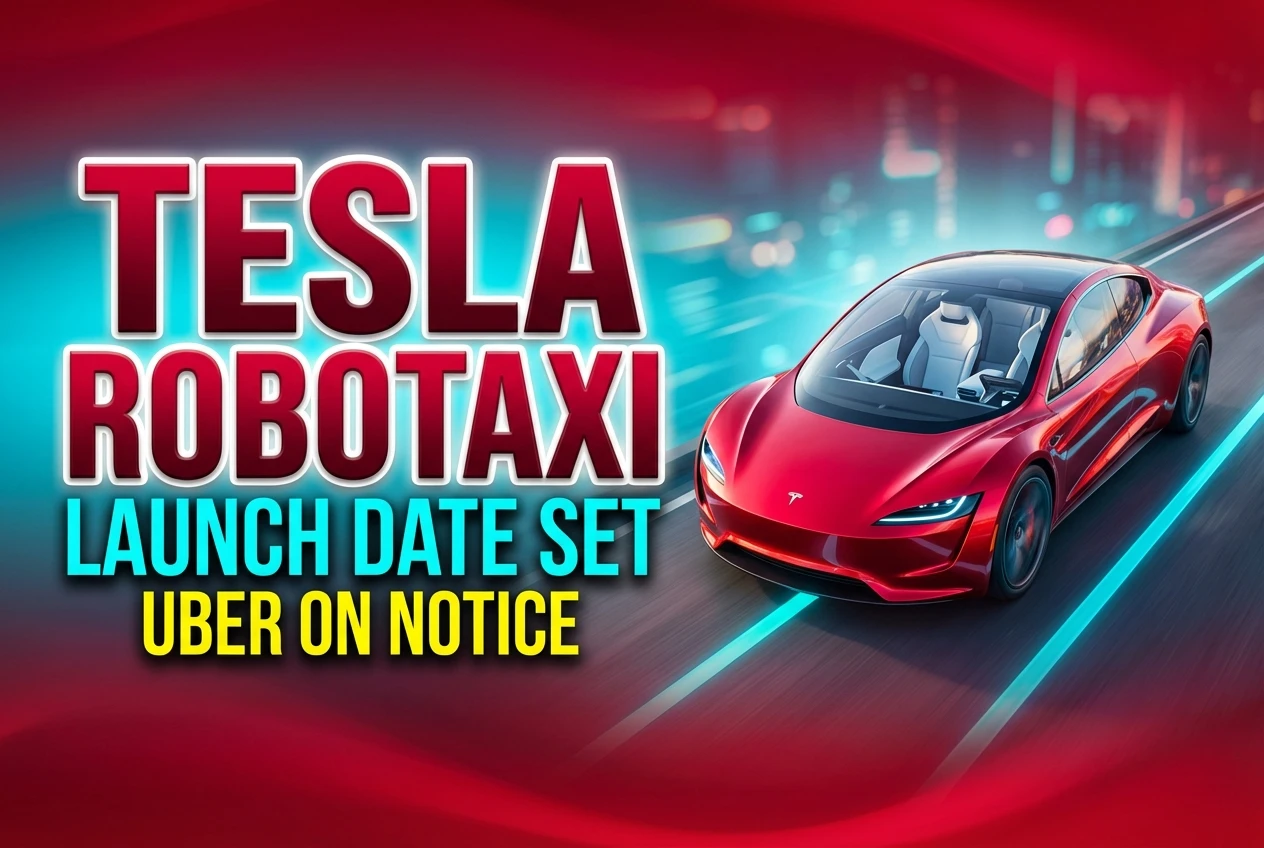
On a Thursday night in California, Elon Musk rolled out a two-passenger car with no steering wheel and no pedals. He called it individualized mass transit. But while the crowd in Burbank cheered the sleek metallic design of the new Cybercab, executives at Uber were weighing the threat of a self-driving fleet that costs just twenty cents a mile to run.
The Two Seat Lounge With No Steering Wheel
The highly anticipated “We, Robot” event felt more like a sci-fi movie premiere than a corporate product launch. Taking over a Warner Bros. studio lot on October 10, the company finally gave the public a look at the hardware meant to replace human drivers. The star of the show was a dedicated autonomous taxi designed from the ground up for a driverless world.
You cannot buy a steering wheel for this vehicle, even as an option. The interior looks more like a modern waiting room than a traditional car cabin, featuring a large central screen and deep seats. Musk announced a target purchase price under $30,000 for the Cybercab, painting a picture of an urban future where personal car ownership becomes completely optional.
This hardware introduces several significant departures from traditional automotive engineering:
- Inductive wireless charging instead of a traditional plug-in port
- Projected operating costs of just twenty cents per mile
- No manual override controls or pedals for human intervention
- Butterfly wing doors designed for tight urban parking spaces
Tesla plans to start unsupervised driving in Texas and California by 2025 using existing Model 3 and Model Y vehicles, paving the way for the Cybercab’s wider release. If the timeline holds, urban transportation is about to look very different.
A Trillion Dollar Bet on Cameras Instead of Lidar
Underneath the shiny exterior, Tesla is taking a technological gamble that sets it apart from every other autonomous vehicle company on the road. The entire robotaxi vision relies entirely on vision-based artificial intelligence, using standard external cameras to navigate the world. There is no Lidar system, no expensive laser scanning hardware, and no high-definition mapping required.
This approach keeps the manufacturing costs incredibly low. It also means the software has to be smart enough to interpret the chaotic real world exactly as a human eye would. According to the company’s early 2024 earnings report, owners have already driven 1.6 billion miles using the Full Self-Driving Beta software, feeding a vast neural network with constant training data.
The cost of autonomous transport will be so low that you can think of it as individualized mass transit. You can think of it as, like, a little lounge.
Financial analysts are watching these developments with dollar signs in their eyes. ARK Invest recently projected that robotaxi platforms could generate up to $10 trillion in enterprise value by 2030. Meanwhile, a 2023 McKinsey report suggested that the average cost of a ride-hail trip could drop by 80 percent once fully autonomous fleets deploy at scale. If Tesla controls both the hardware and the software, they capture all of that profit.
The Ride Share Giant Borrows Cars Instead of Building Them
Uber is playing an entirely different game. Rather than spending billions manufacturing its own vehicles, the current ride-share king is relying on heavyweights like Waymo, Google’s self-driving subsidiary.
The company began offering autonomous rides in a 37-mile section of Austin earlier this year, with Atlanta next on the list. They have also inked deals with other autonomous startups like Avride and Wayve. By aggregating multiple self-driving services onto one app, Uber avoids the steep manufacturing costs while keeping its user base locked into its ecosystem.
| Company | Market Strategy | Technology Ownership |
|---|---|---|
| Tesla | Vertical integration and proprietary fleet | Full Self-Driving (Vision Only AI) |
| Uber | Platform aggregator and dispatch network | Depends entirely on outside vendors |
| Waymo (Alphabet) | Geofenced commercial operations | Hardware sensors and Lidar systems |
Speaking on a podcast in August, Uber CEO Dara Khosrowshahi pointed out the hidden complexities of the business. He noted that it is a very different challenge to build a $50,000 piece of hardware than it is to run a network that has to be available every hour of every day. He openly doubted that any single manufacturer could serve as the sole network for the entire transportation grid.
Wall Street seems to agree with Khosrowshahi for now. The day after the “We, Robot” event, Uber’s stock jumped nearly 11 percent. Equity research analyst John Colantuoni noted that the Burbank showcase was long on vision but short on immediate deliverables, giving investors confidence that Uber’s dominance is safe for the near future.
Real Americans Remain Skeptical About Empty Driver Seats
All the silicon and software in the world means nothing if people refuse to get in the car. While tech executives debate enterprise value and operating costs, the average American seems deeply suspicious of handing their safety over to an algorithm.
A recent poll from the Electric Vehicle Intelligence Report surveying 8,000 adults painted a brutal picture for the industry. A staggering 71 percent of respondents stated flatly that they would not ride in an autonomous taxi. Even worse for the tech sector, 43 percent believe driverless cars should be outright illegal on public roads. That level of public resistance is a significant hurdle for mainstream adoption.
Regulators are paying close attention to that public anxiety. On October 18, just days after the Burbank event, the National Highway Traffic Safety Administration opened a formal investigation into 2.4 million vehicles equipped with Full Self-Driving software. The agency is looking closely at four reported crashes that occurred in low visibility conditions like fog and sun glare.
Legal scholars and safety advocates have been sounding the alarm for years. Bryant Walker Smith, an expert in autonomous vehicle law, recently told reporters that the automaker has never actually demonstrated a system capable of true automated driving without human supervision. Until they do, the technology remains an extended beta test playing out on public streets.
The Hidden Logistics of Running a Robot Fleet
Building a car that can see a stop sign is only half the battle. The unglamorous reality of running a taxi network involves a hundred messy human problems that software cannot easily fix.
Phil Koopman, a professor at Carnegie Mellon, regularly highlights the safety hazards of remote driving and teleoperation. When a vehicle encounters an unexpected construction zone or a flooded street, it often stops and waits for a remote human operator to map a path forward. If the cellular connection drops at that exact moment, the margin for error is razor thin.
The operational challenges extend far beyond the driving software itself. A successful network needs to handle a wide variety of unpredictable situations:
- Managing passenger disputes or forgotten luggage left in the back seat
- Cleaning up spills, trash, or vandalism between anonymous rides
- Navigating complex private apartment complexes without clear mapping
- Providing emergency assistance when a vehicle breaks down in heavy traffic
Uber has spent over a decade perfecting the customer service and logistics side of this business. They know how to handle a rider who throws up in the back seat at 2:00 AM. A company transitioning from building luxury sedans to running a public transit network will have to learn those painful operational lessons from scratch.
The transportation industry is standing at the edge of a fundamental transformation. One side believes that owning the hardware and the artificial intelligence is the key to total market dominance. The other side is betting that maintaining the customer relationship and the dispatch network is the only part of the business that actually matters. Whether you want to buy a #Tesla or simply hail a ride home, the #AutonomousDriving revolution is going to happen whether we are ready for it or not.
Disclaimer: Details in this article regarding vehicle safety investigations are based on publicly available reports from the NHTSA at the time of writing. Official investigation findings may be updated as new evidence emerges. For the latest safety guidelines and investigation statuses, refer to the official federal transportation authority reports.