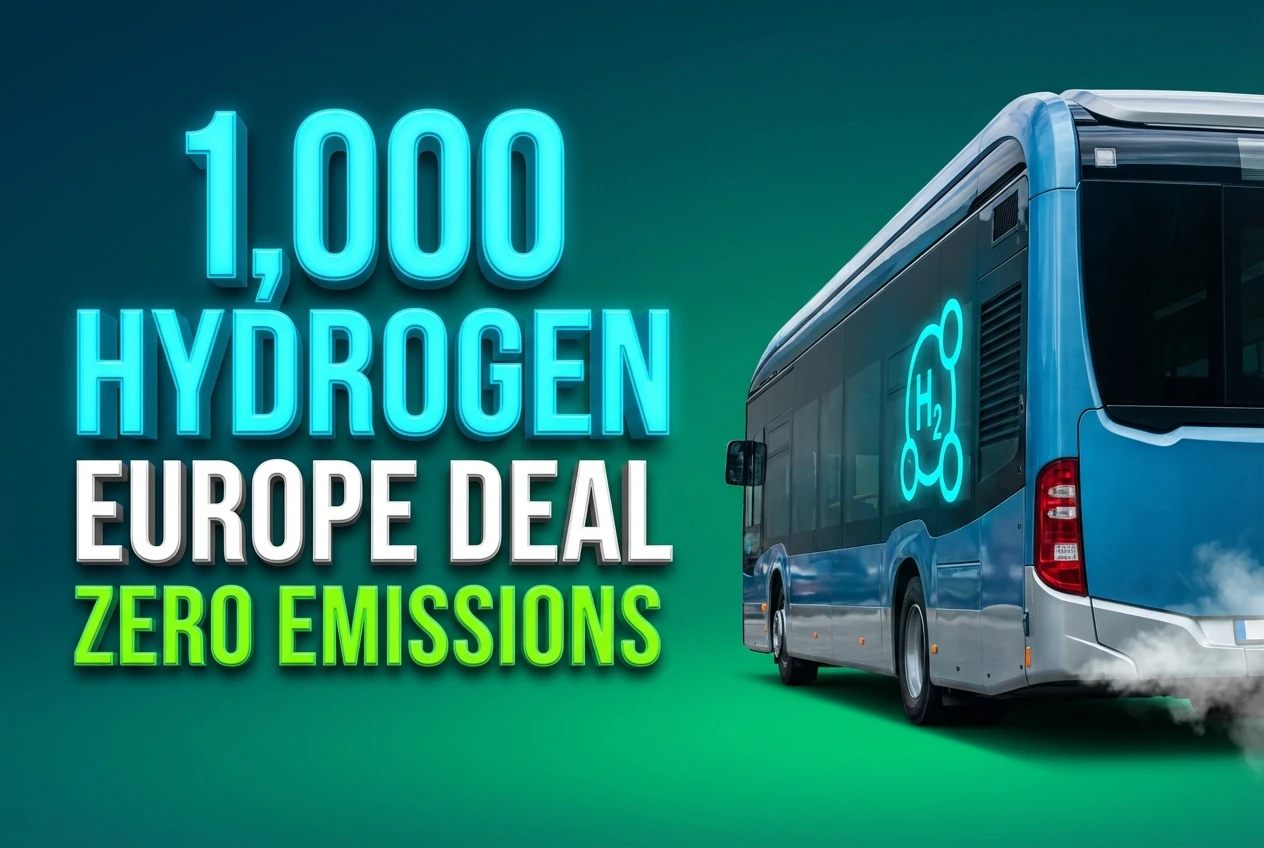
Up until August 2023, the largest single European order Ballard Power Systems had ever secured was a modest 96 units. The market was moving slowly, with municipal transit authorities testing a few clean vehicles at a time. That testing phase ended on April 1, 2024, when the Canadian manufacturer signed a Long Term Supply Agreement to deliver 1,000 hydrogen fuel cell engines to Solaris Bus & Coach.
The deal immediately triggered an 18 percent jump in Ballard shares on the Toronto Stock Exchange. More importantly, it signals that European transit operators are finally ready to scale hydrogen technology from niche pilot programs into full fleet replacements.
The Anatomy of a 1,000-Engine Contract
The sheer scale of this agreement represents a turning point for both companies. The 1,000-unit order consolidates approximately 300 existing orders that were already in the pipeline, while adding a firm commitment for an incremental 700 new engines. These powerplants will be integrated into vehicles built by Solaris, a company that has quietly dominated the zero-emission transit space in recent years.
Ballard and Solaris are not new partners. The two companies have collaborated for over a decade, testing the waters as early as 2014. That relationship matured significantly in 2019 when Solaris launched its first fuel cell bus, the Urbino 12 hydrogen, which relied entirely on Ballard’s internal stack architecture.
According to the official press release regarding the 1,000-engine order, the supply agreement focuses entirely on the heavy-duty transit sector. The manufacturing breakdown highlights exactly what European cities are buying to replace their aging diesel fleets.
| Engine Model | Power Output | Target Vehicle | Order Share |
|---|---|---|---|
| FCmove-HD | 70 kW | 12-meter buses | 80% |
| FCmove-HD+ | 100 kW | 18-meter articulated buses | 20% |
| Delivery Window | N/A | All platforms | 2024 through 2027 |
Solaris hydrogen buses powered by Ballard engines currently operate in more than 22 European cities. Commuters in Munich, Hamburg, and Bratislava are already riding on these platforms daily. By pushing the delivery timeline through the end of 2027, Solaris ensures it has a steady supply of components to meet long-term municipal contracts without manufacturing bottlenecks.
A Billion-Dollar EU Policy Changes the Math
You cannot understand this deal without looking at the regulatory pressures forcing European cities to abandon diesel. The European Commission recently approved €2.5 billion in subsidies for green public transport, creating a financial safety net for municipalities that want to upgrade their fleets but cannot afford the steep upfront costs.
Beyond the carrots, there are significant regulatory sticks. The Revised Clean Vehicles Directive explicitly mandates that public authorities must hit minimum procurement targets for zero-emission buses. If a city wants to buy new transit vehicles, a strict percentage of those vehicles must produce zero tailpipe emissions.
While battery-electric buses still dominate the overall green transit space, making up about 95.4 percent of the market, hydrogen fuel cells are carving out a highly specific niche. Transit authorities are choosing hydrogen over heavy battery packs for three very practical reasons:
- Rapid refueling capabilities that match existing diesel turnaround times
- Extended range for long suburban routes without mid-day charging
- Consistent duty cycles that do not degrade in freezing winter temperatures
A recent Sustainable Bus market report noted that 378 hydrogen buses were registered in Europe in 2024. That is a record figure for the industry, and with Solaris holding over 500 units in its immediate order book, that number is guaranteed to climb sharply over the next two years.
Texas Gigafactory Secures a $54 Million Boost
While the Solaris deal is a European victory, Ballard’s manufacturing future is heavily tied to the United States. On the exact same day the Solaris contract was announced, Ballard secured a major financial win from the U.S. federal government.
The company was awarded $54 million in investment tax credits under the 48C Advanced Energy Project program. This funding, managed by the IRS and the Department of Energy, is earmarked specifically for a new fuel cell gigafactory located in Rockwall, Texas. This facility is crucial for Ballard to scale its global production capacity and fulfill mega-orders like the one signed with Solaris.
It really shows the market maturity. A few years ago, we were getting orders for one, two, and then five and 10. And now… Solaris has the biggest market share for all zero-emission buses in Europe.
The quote above from Nicolas Pocard, Vice-President of Marketing at Ballard, perfectly captures the transition. The industry has spent a decade in the pilot phase. Now, the European and North American bus markets are driving real revenue, contributing 60% of Ballard’s total 2024 revenue.
Why Hydrogen Still Costs More Than Battery Power
Despite the optimism surrounding the 1,000-engine order, the transition to hydrogen is not without significant friction. The primary hurdle remains the staggering price tag attached to these vehicles.
According to a comprehensive Coherent Market Insights report, the average cost of a hydrogen bus is projected to sit between $750,000 and $900,000 in 2025. That is substantially higher than a standard battery-electric bus, and nearly double the cost of a traditional diesel model.
This pricing reality is exactly why the Ballard and Solaris partnership matters. By securing a 1,000-unit order, Ballard can finally achieve scaled deployment of its FCmove engines. Manufacturing 1,000 units instead of 10 at a time unlocks economies of scale, drives down the per-unit cost of the internal fuel cell stacks, and allows Solaris to price its buses more competitively against battery-electric alternatives.
Europe is widely expected to lead the global hydrogen bus market, with analysts projecting a 35 percent global market share for the continent by 2025. As long as the European Union continues to fund the gap between diesel budgets and zero-emission reality, manufacturers with proven hardware will keep winning the bids.
The era of buying a single hydrogen bus for a press photo is over. Fleet operators are now calculating the long-term economics of overhauling their entire transit networks, and they are betting heavily on partnerships that can actually deliver the hardware on time. With thousands of engines now actively entering the production pipeline, the push toward #HydrogenPower has finally moved from the laboratory to the reality of daily #EuropeanTransit.