Australian rally driver Brendan Reeves watched his dashboard carefully as the kilometers ticked past. The trip computer on his zero-emission SUV indicated he should have run out of fuel hours ago. Yet, the vehicle kept quietly rolling across the outback. When the wheels finally stopped turning, he had just set a world distance record for a hydrogen-powered passenger car.
Outlasting the Trip Computer
The low fuel warning illuminated when the vehicle hit the 686-kilometer mark. Most drivers would panic and immediately search for the nearest station. Reeves simply kept his foot steady on the accelerator and pushed further into the harsh Australian landscape. He was piloting an unmodified hydrogen-powered Hyundai Nexo, aiming to prove exactly how far modern fuel cell technology could go before running dry.
The journey began early in the morning at Essendon Fields in Melbourne. The original target was the historic mining city of Broken Hill in New South Wales. However, the car proved far more efficient than anyone on the engineering team anticipated. After passing the 807-kilometer mark, the onboard systems showed the vehicle could still make significant progress beyond the planned stopping point.
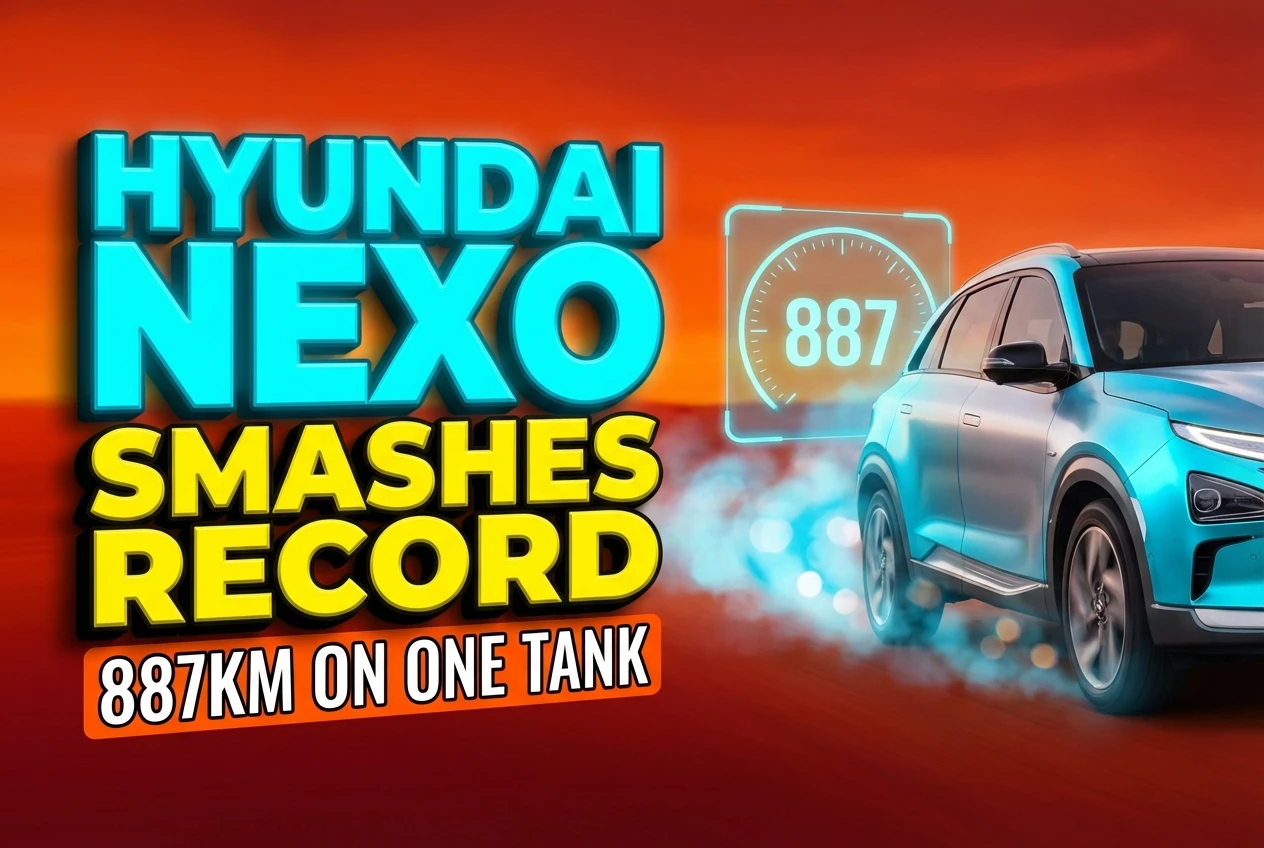
Reeves made a quick decision to bypass his original destination. He steered the vehicle toward Silverton, a remote dusty outpost on the edge of the desert. The SUV eventually rolled to a gentle halt after logging a GPS-confirmed distance of 887.5 kilometers. This comfortably beat the previous global milestone set in November 2019, when French explorer Bertrand Piccard drove the exact same model of car 778 kilometers across France.
A Rally Driver With a Different Strategy
Motorsport professionals are usually focused on getting from point A to point B as fast as physically possible. For this specific challenge, Reeves had to completely rewire his driving instincts. He could not throw the car into corners or accelerate hard out of bends like he would in a competition stage. Instead, he adopted a strict performance-centric approach focused entirely on energy preservation.
“As a rally driver, I’ve always wanted to achieve a world record, but I could never have guessed it would come this way,” Reeves explained after stepping out of the vehicle. “As we set out from Essendon Fields in the early morning, I found the NEXO immediately familiar and easy to drive.”
To maximize the distance, Reeves relied on some old-fashioned wisdom. He actively applied several fuel-saving techniques his father had taught him about driving commercial trucks efficiently. These strategies included maintaining steady momentum over rolling hills, looking far ahead to avoid unnecessary braking, and keeping the throttle position as static as possible. The combination of professional vehicle control and these basic trucking principles resulted in numbers that surprised the official timekeepers.
The Efficiency Math Behind the Milestone
The actual data recorded during the 13-hour drive highlights just how far alternative fuel technology has evolved. The car ran continuously for 13 hours and 6 minutes without a single stop to recharge or refuel. Over that entire duration, the vehicle maintained an average speed of 66.9 kilometers per hour.
What makes a fuel cell vehicle unique is that it generates its own electricity on the move. Rather than pulling power from a heavy battery pack, the car mixes stored hydrogen with oxygen from the outside air. The only resulting byproduct that leaves the tailpipe is clean water. To achieve this record distance, the car consumed a total of 6.27kg of hydrogen, which translates to a highly efficient 0.706kg per 100 kilometers.
The mechanics of the record run produced several interesting secondary statistics:
- The hydrogen is safely stored at 700 bar of pressure in three carbon-fiber reinforced tanks.
- The official WLTP certified range for the vehicle is typically around 660 kilometers.
- Recharging the entire fuel system takes just three to five minutes at a compatible station.
- The total trip time was completed in a single continuous driving session.
| World Record Detail | 2019 France Record | 2021 Australia Record |
|---|---|---|
| Driver | Bertrand Piccard | Brendan Reeves |
| Verified Distance | 778 km | 887.5 km |
| Vehicle Model | Hyundai Nexo | Hyundai Nexo |
| Operating Environment | European Highways | Australian Outback |
Beyond simply traveling a long distance, the car was actively cleaning the environment as it drove. Because fuel cells require completely pure oxygen to function properly, the car features an advanced internal filtration system. During the trip to Silverton, the vehicle purified 449,100 liters of air. To put that into perspective, that is equivalent to the daily breathing requirements of 33 adults.
Proving the Viability of Hydrogen Power
This outback test was designed to highlight a specific advantage over traditional battery electric cars. In a vast country with long stretches of empty highway, range anxiety remains a serious barrier to adopting new automotive technology. The ability to drive almost 900 kilometers and then refill the tanks in under five minutes mirrors the convenience people expect from their current gasoline cars.
The hydrogen fuel cell is a key part of Hyundai’s future. This record-breaking distance is a testament to the efficiency and viability of the NEXO as a daily driver.
The quote above comes from Charlie Lowndes, a product planning manager at Hyundai Motor Company Australia, who views this milestone as a crucial proof of concept. The Nexo recently became the first hydrogen-powered vehicle certified for sale in the local Australian market. However, the true challenge is not the capability of the vehicles themselves, but the lack of places to refill them.
Infrastructure is slowly catching up to the automotive engineering. Through the National Hydrogen Strategy, the Australian Government is actively investing in new fuel hubs to support zero-emission transport. As these public refueling stations begin to open, the prospect of taking a cross-country family road trip without burning a single drop of fossil fuel becomes a practical reality rather than a science experiment.
The long highway stretching out toward Broken Hill has always tested the limits of both drivers and machines. By conquering that route with nothing but water left in its wake, the #HyundaiNexo has proven that the future of long-haul travel doesn’t necessarily mean compromising on distance. The #HydrogenFuture is quietly arriving, one record-breaking road trip at a time.