Three months ago, selling an advanced artificial intelligence processor to Beijing was considered a strict national security risk. Today, it is a direct revenue stream for the United States government.
The Biden-era restrictions that halted semiconductor exports in April 2025 have been entirely dismantled by the Trump administration. Now, the silicon is flowing again, but with an unprecedented catch that treats global tech exports more like a toll road than a free market.
The 15 Percent Deal Changes Everything
When the Commerce Department shut the door on advanced semiconductor exports earlier this year, the directive seemed absolute. Washington labeled the hardware a severe threat, arguing that American components should never fuel a foreign adversary’s artificial intelligence infrastructure. That rigid stance evaporated in July.
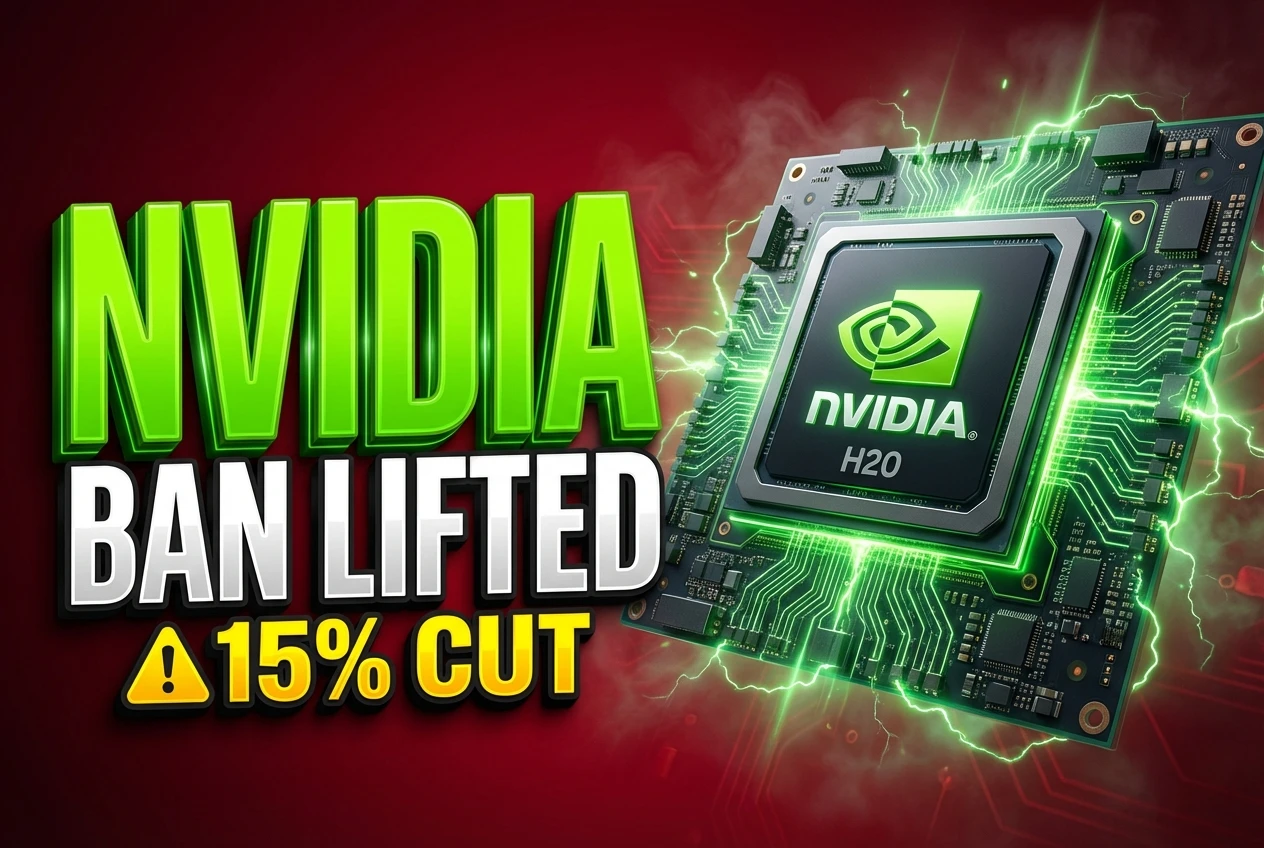
Under a novel agreement brokered between tech executives and federal regulators, the White House quietly granted new export licenses for the hardware. The condition for this approval requires Nvidia to sign a contract where it remits 15 percent of its total China H20 revenue directly to the U.S. Treasury. It is a striking policy shift that effectively taxes domestic innovation to fund the federal government while simultaneously unblocking a vital supply chain.
“What we are seeing is a transition from ideological confrontation to transactional pragmatism. Decisions on critical technologies like Nvidia’s chips will ultimately land on the President’s desk.” – Howard Lutnick, U.S. Commerce Secretary
This aggressive pivot stems from the recent Busan Declaration, a diplomatic truce negotiated between President Trump and President Xi Jinping. The framework sidesteps traditional embargoes in favor of financial leverage, treating high-end processing power as a bargaining chip alongside rare earth metals and agricultural tariffs.
White House AI and Crypto Adviser David Sacks framed the reversal as a competitive necessity rather than a concession. He argued that allowing these sales to restart would actually help American firms maintain dominance against rising foreign competitors.
Why Tech Giants Want a Restricted Processor
The hardware at the center of this geopolitical tug-of-war is not actually Nvidia’s best work. The H20 processor was specifically engineered to comply with earlier export controls, making it a deliberately weakened version of the flagship H100 architecture.
To satisfy federal regulators, the H20’s raw computing power is restricted to approximately 15 to 30 percent of what the flagship model can output. You might expect that kind of performance drop to kill buyer interest, but the reality is entirely different.
Chinese tech companies are buying these units as fast as Taiwan Semiconductor Manufacturing Company can press them. The secret lies in the memory architecture. Even with its core processing severely throttled, the chip maintains a high memory bandwidth of 4 TB/s, which is the exact specification needed to run large language models efficiently after they have been trained.
Instead of waiting for domestic manufacturing to catch up, Chinese labs have shifted into overdrive to build alternative frameworks. They are buying the restricted processors in bulk and linking them together to compensate for the reduced processing speed.
The technical ecosystem relies heavily on a few key factors:
- High-speed data transfer rates between clustered server units
- Compatibility with Nvidia’s universally adopted CUDA software platform
- Reliable manufacturing yields that domestic foundries cannot currently match
- The ability to run inference tasks on previously trained models
Billions Lost and the Sudden Rush to Restock
Before the export restrictions hit, Nvidia controlled 95 percent of the Chinese artificial intelligence hardware market. By the time summer arrived, that dominance had plummeted.
The April ban forced local developers to look inward, and domestic rivals like Huawei and Cambricon quickly stepped into the void. SemiAnalysis data revealed that Nvidia’s market share dropped to roughly 50 percent by mid-2025. The financial toll was immediate, resulting in an estimated quarterly revenue loss of $5.5 billion for the California-based tech giant.
This explains why CEO Jensen Huang made three separate trips to Beijing this year to lobby for continued market access. When the green light finally flashed in July, the company wasted no time trying to reclaim its territory.
| Market Metric | 2025 Data Point |
|---|---|
| New TSMC Chip Order | 300,000 units |
| Existing Regional Inventory | 600,000 to 700,000 units |
| Forecasted AI Funding Growth | 48% increase (Bank of America) |
| Previous Year Sales (2024) | 1,000,000 units |
On July 29, the company placed a rush order for 300,000 high-end H20 chipsets from TSMC to meet the surging backlog of Chinese demand. The Taiwan-based foundry is now operating near maximum capacity as rival manufacturers also race to secure production lines.
Speaking to reporters in Beijing on July 15, Huang confirmed the breakthrough. He noted that the local market was incredibly dynamic, making it essential for American companies to remain competitive and serve developers in the region.
The Strategic Gamble of Arming a Direct Rival
While Washington tallies its new licensing fees, security researchers are paying close attention to what these processors are actually building. The irony of the current arrangement is hard to ignore.
American hardware is now actively helping foreign developers build systems designed to eventually outperform domestic models. The January 2025 launch of DeepSeek – a homegrown framework built on limited resources that rivaled early ChatGPT iterations – served as a loud warning bell for Western analysts. Chinese institutions in Beijing and Wuhan have shifted into overdrive to find ways around traditional hardware limits.
If these alternative architectures prove successful, they could leapfrog the current industry standard entirely. The current policy essentially bets that collaboration accelerates innovation for everyone, and that keeping the American tech stack as the global foundation is safer than building a digital wall.
There are several distinct risks to this open-door approach:
- The 15 percent revenue deal could be challenged in international trade courts.
- The sudden influx of 300,000 processors might give local labs the compute power they need to break past their current bottlenecks.
- Domestic American startups might struggle to secure TSMC manufacturing time while the foundry is tied up with international orders.
Beijing has been careful to frame its ambitions softly. A spokesperson for the Chinese Embassy recently emphasized that they are seeking fairness and inclusion rather than supremacy, referring to their development goals as benevolent and human-centered.
For now, the policy uncertainty has manufacturers scrambling to frontload their shipments. Nobody knows exactly how long these current export licenses will remain valid, and history shows that trade directives can change overnight. But as the foundries run hot to fulfill these massive orders, the ongoing #TechGeopolitics debate is taking a backseat to cold, hard cash, cementing #Nvidia as the undeniable architect of both sides of the global tech race.