If you thought a two-decade-old online game was quietly fading away, think again. The population in Final Fantasy XI has surged so aggressively this year that the developers are hitting the emergency brakes. Starting this July, the game’s most populated server is pulling up the drawbridge to prevent total gridlock. It is a rare problem for a retro title to have, but it shows just how much life is left in Vana’diel.
The Three Immediate Restrictions Coming This July
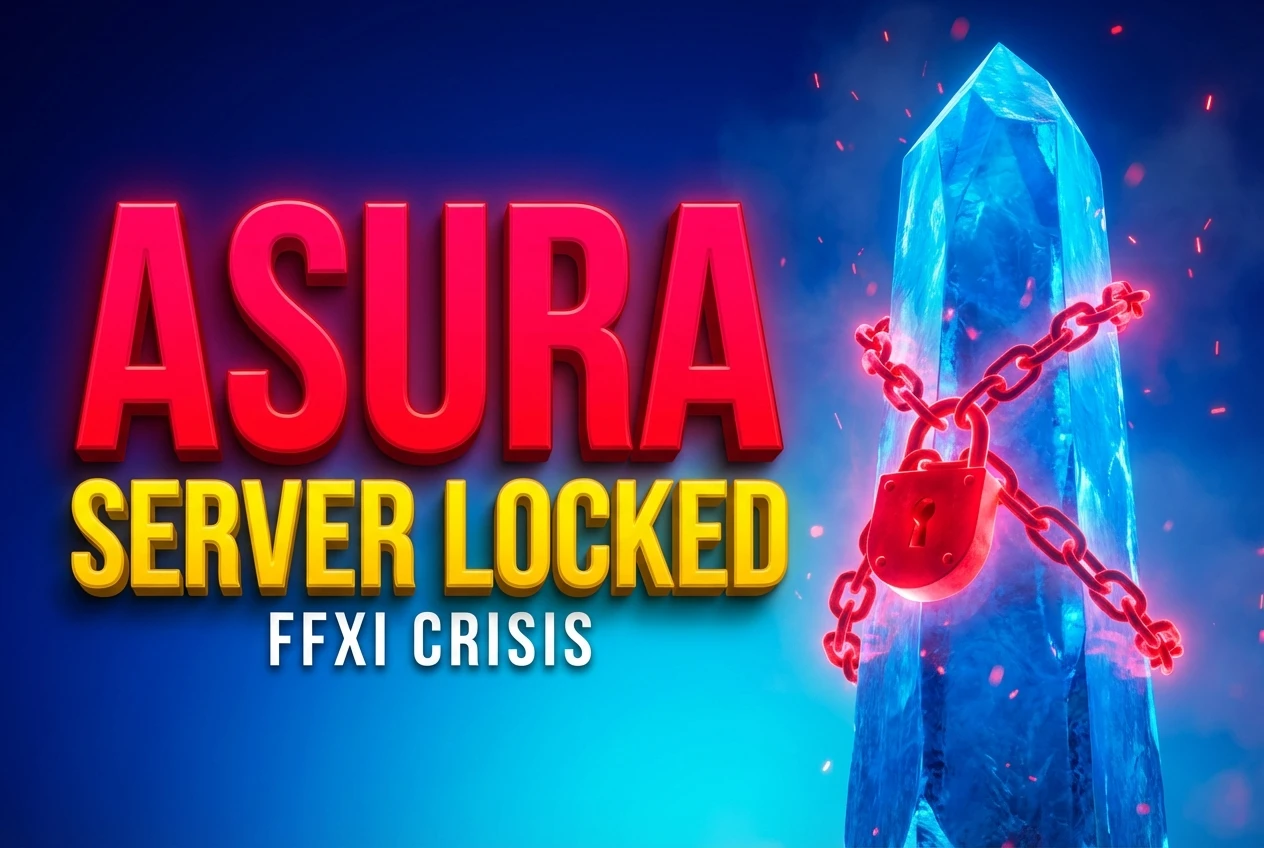
Producer and Director Yoji Fujito confirmed that the development team is stepping in to manage the heavy load. Starting on July 29, 2025, Square Enix is enacting three specific rules designed to cool down the server. If you currently play on a different world and were hoping to join your friends on Asura, you will need to put those plans on hold. The community has a few days to prepare, but once the deadline hits, the gates are closed.
The first major change is halting new character creation entirely on the server. There is a small loophole here for veteran players. If your account already has at least one character established on Asura, you can still create an alt character there. For completely new accounts, the option will simply be grayed out at the character selection screen. This ensures that current residents can still manage their rosters without bringing fresh accounts into the crowded environment.
The second restriction tackles the migration issue directly. Square Enix has confirmed that all incoming World Transfers to Asura are temporarily blocked. The developers often use discounted transfer events to balance server populations naturally, but the current situation requires a hard stop. You can still transfer off the server if the crowds are too much, but nobody is allowed to transfer in. Players sitting on Odin or Bahamut are staying exactly where they are.
Finally, the development team is modifying how player incentives work on this specific world. The Vana’diel Adventurer Recruitment program will no longer apply to anyone starting on Asura. Here is what players lose out on by missing the recruitment rewards:
- Copper AMAN Vouchers used for early game currency
- The Guide Beret and Sprout Beret for leveling speed
- Starter travel items like the Miniature Airship
- The Detonator Belt for early combat stats
Fujito wants players to know that these changes are temporary and tactical. The goal is to make the game enjoyable for everyone, rather than punishing the community for wanting to play together.
A Retro Game Breaking Under Modern Pressure
Final Fantasy XI originally launched in 2002, making it an absolute ancient artifact in the online gaming space. Yet the game is still standing, still receiving monthly updates, and shockingly, still growing. The recent population boom caught the developers completely off guard.
A large part of this current bottleneck stems from the long-requested race change service introduced in early 2025. Players had been asking for the ability to swap their character models for nearly two decades. When Square Enix finally delivered the feature, it brought a wave of returning veterans eager to redesign characters they had played since the early 2000s. It was a simple cosmetic update, but it reinvigorated the entire community.
That single feature stirred up significant buzz, but it is not the only draw. The game is experiencing a mini-revival thanks to several key updates:
- New race change options added after nearly two decades
- A comprehensive Limbus content revamp expected later this year
- Consistent quality-of-life tweaks delivered monthly
When you combine fresh high-level content with consistent seasonal events, you create a formula for a sustained revival that has simply tipped over into overflow.
Many players are drawing comparisons between this situation and the server buckling that happened during the Final Fantasy XIV Endwalker launch window. While the scale of the two games is different, the growing pains feel remarkably similar. People want to play, and the digital infrastructure can only handle so many simultaneous connections before the experience degrades.
Why English Speakers Refuse to Leave Asura
The obvious question for anyone outside the community is why one specific server is causing so much trouble. Over the years, Asura slowly evolved into the unofficial main server for active players in the West. It became a self-fulfilling prophecy where the high population attracted even more people looking for groups.
For starters, it hosts the largest English-speaking community by a wide margin. When new players ask for advice on Reddit forums or Discord channels, veterans almost universally point them toward Asura. This creates a funnel effect where almost all new Western accounts end up in the exact same starting cities.
This concentration of players has a direct impact on the in-game economy. The Final Fantasy XI Auction House relies entirely on player-driven supply and demand. Because Asura has the most active crafters and buyers, it is the easiest place to earn currency and find rare gear.
| Server Metric | Asura Reality |
|---|---|
| Economy Status | Most active Auction House with high item turnover |
| Community Focus | Primary hub for English-speaking group coordination |
| Player Experience | High competition for experience point camps |
The downside to this bustling economy is the sheer lack of physical space. Final Fantasy XI relies heavily on open-world zones where players must compete for monsters to earn experience. When thousands of people are trying to hunt in the same areas, progress slows to a crawl. The developers are hoping these July restrictions will naturally push players to explore quieter Worlds where the competition is far less intense.
Echoes of the Historic 2020 Lockdowns
This is actually not the first time Square Enix has been forced to put a padlock on Asura. Long-time fans remember a very similar crisis that unfolded just five years ago. The current management under Yoji Fujito is utilizing the exact same playbook that his predecessor relied on during a period of unprecedented global gaming activity.
In May 2020, the global lockdowns and the 18th-anniversary celebrations combined to create a perfect storm of server congestion. At the time, player tracking tools showed peak concurrent user counts exceeding 3,000 players on Asura alone. That was often double the population of the next largest server, leading to severe login queues and instanced area crashes. According to a digital games market analysis published that year, the stay-at-home period drove a 20 to 30 percent increase in active subscriptions across legacy online titles.
The problem escalated when Square Enix launched the Return Home to Vana’diel Campaign, offering free login periods for inactive accounts. Data from community analysis estimated that 82 percent of the active English-speaking player base was crammed onto this single world.
“The number of concurrent players has been increasing significantly, and we are working to ensure that everyone can enjoy the game in a stable environment.”
That statement from former Producer Akihiko Matsui highlights how persistent this issue has been. Square Enix has traditionally avoided locking servers for long periods, preferring to encourage voluntary moves via discounted transfers. But when a server hits its hard technical limit, voluntary measures are no longer enough to protect the experience for paying subscribers.
This mid-summer capacity crisis proves that classic online experiences still hold immense value in the modern gaming market. As legacy titles continue to receive meaningful updates, we will likely see more studios wrestling with how to handle unexpected waves of nostalgia. For anyone currently waiting in a login queue, the temporary restrictions cannot come fast enough. The health of the #FinalFantasyXI ecosystem depends on spreading out the player base, and this forced break for the #AsuraServer might be exactly what the game needs to thrive for another twenty years.