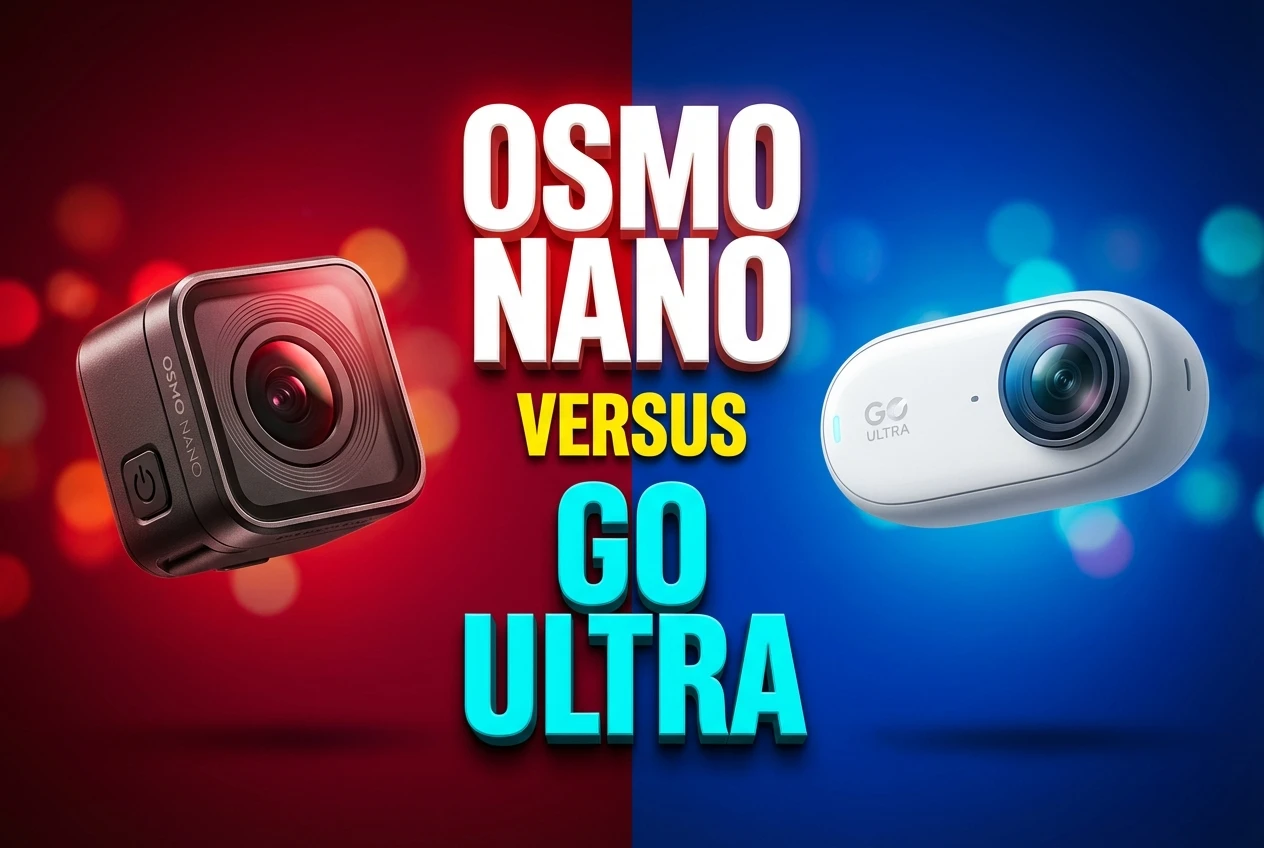
If you want to stick a high-resolution camera on a basketball, your options just got a lot more interesting. DJI’s new Osmo Nano brings flagship-level video features to a magnetic square that weighs less than a tennis ball, directly targeting the wearable market dominated by the Insta360 Go series. But while this $399 gadget packs serious professional tools, it arrives with a glaring absence on United States store shelves.
52 Grams of 4K Video Power on Your Shirt
The camera module alone tips the scales at just 52 grams. When you pull the tiny lens unit away from its Multifunctional Vision Dock, you are left with a surprisingly capable piece of hardware that mounts magnetically to fences, cars, or your clothing. DJI managed to squeeze a 1/1.3-inch sensor inside the tiny frame, giving creators the ability to shoot clean 4K video at 60 frames per second without lugging around a heavy rig.
Insta360 is not sitting back quietly as a new rival enters their territory. Their Go Ultra, launched in August 2025, fired back with a larger 1/1.28-inch sensor that measures 221 percent larger than the previous Go 3S. This size bump helps the Insta360 grab more light in dark environments, making it a strong contender for indoor and evening recording sessions.
The technical differences between the two devices define who they are built for. DJI leaned heavily into professional workflows with their release. The Osmo Nano supports 10-bit D-Log M color profiles, which gives video editors far more flexibility to adjust shadows and highlights in post-production. Insta360 took a different route, prioritizing high-speed capture by offering 120 frames per second at a crisp 2.7K resolution for dramatic slow-motion clips.
Choosing between the two base units comes down to these core technical advantages:
- The Osmo Nano delivers flat color profiles for advanced grading.
- The Go Ultra uses a custom 5nm AI chip for low-light enhancement.
- DJI offers seamless integration with their existing wireless microphone ecosystem.
- Insta360 pushes pure speed with its slow-motion capabilities.
The Price Tag That Excludes the US Market
A $50 price gap does not sound like a huge deal until you multiply it by millions of beginner creators looking for their first proper camera. DJI aggressively priced the 64GB Osmo Nano at $399, intentionally undercutting the $449.99 retail tag of the Insta360 Go Ultra. This pricing strategy reflects an ongoing battle to capture entry-level vloggers before they commit to an expensive camera ecosystem.
However, the global launch came with a significant caveat. When the Osmo Nano dropped on September 23, 2025, the device was notably absent from official storefronts in the United States. This missing availability points to the ongoing regulatory scrutiny and trade restrictions that have complicated DJI’s product rollouts over the past year.
DJI remains dedicated to the US market and is optimizing our strategy to best serve our customers amidst evolving local conditions.
Despite the regional hurdles, the spec sheets show two companies operating at the absolute peak of miniaturized hardware design. Neither camera feels like a toy, and both pack components that would have required a large backpack just five years ago.
| Feature | DJI Osmo Nano | Insta360 Go Ultra |
|---|---|---|
| Camera Module Weight | 52 grams | 53 grams |
| Base Price (64GB) | $399.00 | $449.99 |
| Image Sensor | 1/1.3-inch | 1/1.28-inch |
| Standout Software Feature | 10-bit D-Log M color | PureVideo AI processing |
Wireless Audio Decides the Winner for Vloggers
You are filming a street food review in a loud night market, and the built-in microphone on your camera just captures chaotic wind noise. This is where the battle between these two devices actually gets decided. While both cameras feature solid onboard microphones for quiet rooms, real-world recording demands better sound solutions.
DJI holds a distinct advantage here thanks to its established accessory lineup. Over 90 percent of tech reviewers already rely on DJI’s Bluetooth microphones, and the Osmo Nano pairs instantly with these external transmitters. You can clip a wireless mic to your collar, stick the camera to a streetlamp ten feet away, and still record perfectly synced studio audio without plugging in any receivers.
Insta360 approaches the audio problem through software rather than hardware accessories. The Go Ultra relies heavily on AI-driven background noise reduction baked into its 5nm processor. It isolates human voices and strips away passing traffic noise directly within the camera itself. For creators who refuse to carry extra gear, this software trick is often enough to salvage a windy outdoor take.
To get the best results out of either system in loud environments, you need to understand their limitations:
- DJI’s onboard mic struggles in heavy city traffic without an external transmitter connected.
- Insta360’s AI audio sounds slightly compressed when removing very loud background noise.
- Both cameras max out around 90 minutes of battery life when detached, limiting long interviews.
A Billion Dollar Rivalry Between Shenzhen Giants
DJI and Insta360 originally stayed in their own lanes. DJI ruled the skies with drones, while Insta360 dominated the 360-degree camera space. Over the past year, those boundaries have completely vanished. Insta360 rolled out their own consumer drone, and now DJI has pushed aggressively into the modular wearable category that Insta360 essentially invented five years ago with the original Go series.
This turf war is generating serious revenue. According to their 2025 fiscal data, Insta360 reported an incredible 9.858 billion yuan in revenue, representing a 76 percent year-on-year increase. Their operating income spiked dramatically in the third quarter alone following the Go Ultra launch. Meanwhile, a market overview analyzing ecommerce sales notes that online retail now accounts for 66 percent of total revenue in the broader action camera industry.
The global valuation for these rugged little devices hit $2.48 billion in 2024, and analysts at Fortune Business Insights tracking industry growth project the market will climb to over $19 billion by the next decade. That kind of money explains why these two tech giants are fighting so hard for real estate on your backpack straps and bicycle helmets.
Competition drives better technology, and everyday users are reaping the benefits. We now have waterproof, stabilized 4K cameras that fit in a coin pocket. As the #ActionCamera market expands into entirely new form factors, devices like the #OsmoNano prove that professional recording gear does not need to look or feel like traditional studio equipment.