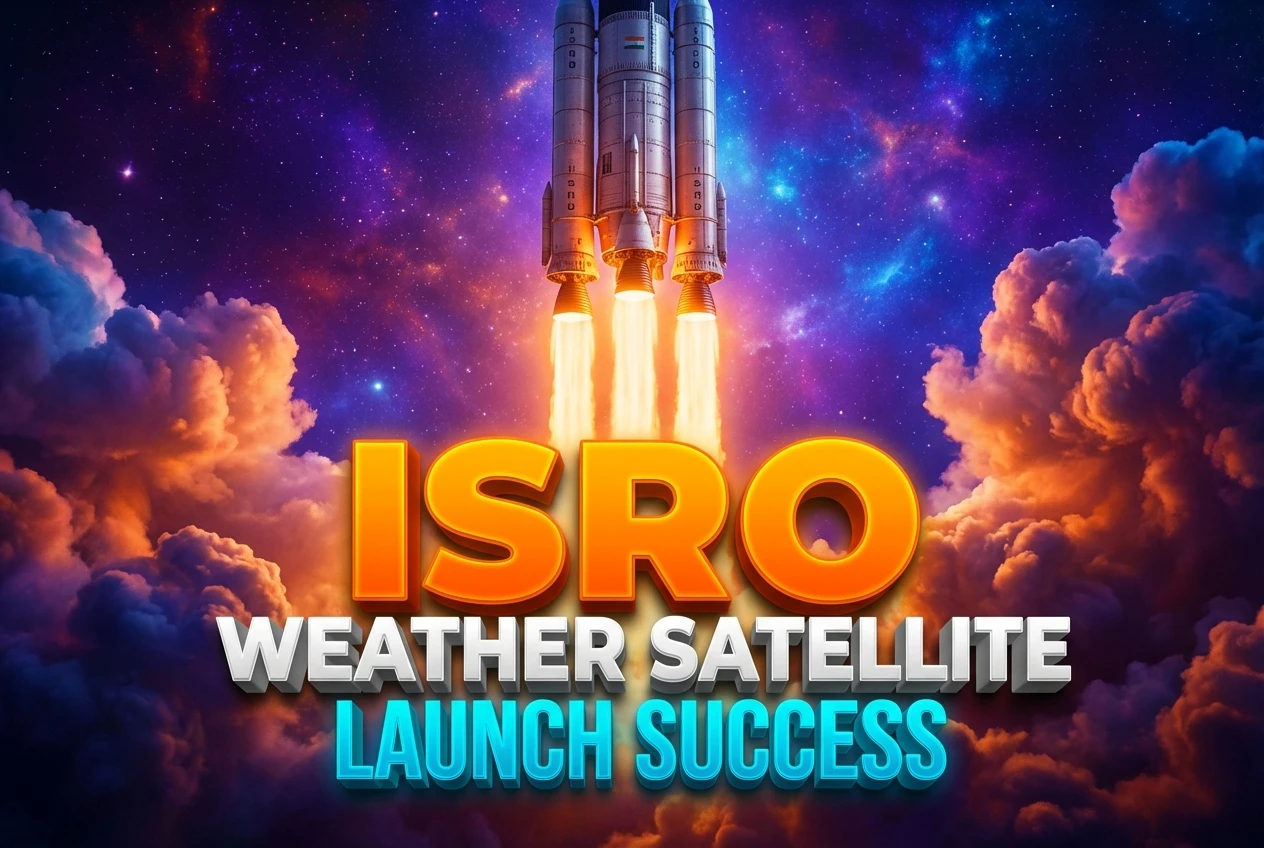
Late Thursday afternoon, the Indian Space Research Organisation sent its newest weather monitoring tool into the clouds. The GSLV-F05 rocket lifted off from Sriharikota at exactly 5:00 pm on September 8, 2016, carrying the INSAT-3DR satellite. This successful launch gives meteorologists a dedicated new platform to track storm systems and coordinate rescue operations across the region.
A Ten Year Eye in the Sky for Weather Operations
The satellite weighed exactly 2,211 kilograms on the launch pad, with more than half of that mass coming from the propellant needed to maintain its orbit. Engineers have designed for a ten-year mission life, giving the scientific community a long-term reliable source of atmospheric data. The internal instruments represent a significant upgrade over previous generations of orbital weather monitors.
To capture accurate meteorological data, the platform relies on two primary instruments. The satellite is equipped with a 19-channel sounder that measures temperature and humidity at various altitudes in the atmosphere. This works alongside a six-channel imager that scans the Earth below in visible, shortwave, and thermal bands.
Forecasters often struggle to track cloud movements after the sun goes down, but this new hardware changes that dynamic. The imager includes a specialized Middle Infrared band specifically tuned to capture night-time pictures of low clouds and fog banks. This means meteorologists no longer have to wait for sunrise to see how a coastal fog system is developing.
Here are the primary components powering the new orbital platform:
- A high-resolution six-channel optical and infrared imaging system
- An atmospheric sounder for measuring vertical temperature profiles
- A dedicated search-and-rescue communication transponder
- Data relay systems for collecting ground-based weather station information
- Two deployable solar arrays generating the necessary operational power
The Indigenous Cryogenic Engine Proves Its Reliability
The Geosynchronous Satellite Launch Vehicle program had previously struggled with reliability, notably facing back-to-back failures in 2010. That history made this tenth flight a critical proving ground for the engineering teams involved. Today marks the first operational flight featuring an indigenous cryogenic upper stage, proving that the domestic space program can handle complex super-cooled fuel systems.
Cryogenic engines use liquid hydrogen and liquid oxygen, which must be kept at extremely low temperatures right up until the moment of ignition. When fired in the vacuum of space, this third stage generates 73.55 kN of nominal thrust to push the heavy payload into its final geostationary transfer orbit. Developing this technology domestically took years of trial and error.
Today we have achieved another landmark for our GSLV Mk II. The launch vehicle performed extremely well.
That confirmation came directly from A. S. Kiran Kumar, the Chairman of the space agency, as he addressed reporters at the Satish Dhawan Space Centre shortly after the payload separated from the rocket. The achievement signals a shift in how the country handles heavy cargo. Maxime Puteaux, a space industry policy consultant, noted to reporters that a successful GSLV Mk II program could partially reduce the dependency on foreign launch providers for placing heavy communication and weather platforms into orbit.
The original launch sequence was actually scheduled for August 28 before being delayed by several days to address technical checks. Even on launch day, the ignition time shifted from 4:10 pm to 5:00 pm to ensure all systems were fully ready for the climb.
Real Time Data for the India Meteorological Department
When severe weather builds over the Bay of Bengal, forecasters need continuous updates without blind spots or data blackouts. The new satellite will be stationed at 74 degrees East longitude, placing it in a perfect geostationary position to monitor the entire subcontinent. To keep all these instruments running without interruption, the satellite generates 1.7 kilowatts of power through its sun-tracking solar arrays.
The India Meteorological Department will serve as the nodal agency for satellite application services, pulling down the raw imagery and converting it into usable forecasts. They plan to use the new platform in a staggered mode alongside the older INSAT-3D hardware launched back in 2013.
Director General of the IMD, K J Ramesh, explained the strategy for handling the two platforms simultaneously. He noted that the new hardware acts as a fallback system, but while both are working at full efficiency, they will simply enrich the overall data pool available to forecasters.
By staggering the imaging cycles between the two orbiting platforms, scientists can achieve much faster refresh rates for severe weather tracking. Instead of waiting for a single camera to complete its cycle, the ground stations can pull alternating images from both sources to build a near-continuous loop of storm movements.
Three Stages of Power to Reach Geostationary Orbit
The rocket itself is a towering piece of engineering built specifically to heave multi-ton payloads away from Earth’s gravity. The GSLV-F05 utilizes three distinct stages of propulsion to complete its journey. The very bottom of the vehicle relies on solid rocket motors surrounded by liquid-fueled boosters to get the heavy vehicle off the launch pad.
The core stage measures 2.8 meters across, providing the structural backbone for the entire assembly. The strap-on boosters attached to the sides measure 2.1 meters in diameter and burn simultaneously with the core to provide maximum initial thrust.
Here are the structural dimensions of the vehicle stages:
| Flight Stage | Diameter | Length |
|---|---|---|
| Strap-On Boosters | 2.1 meters | 19.68 meters |
| Core Stage | 2.8 meters | 20.18 meters |
| Second Stage | 2.8 meters | 11.57 meters |
| Cryogenic Upper Stage | 2.8 meters | 8.72 meters |
The national broadcast networks treated the launch as a major public event. The liftoff was streamed live across official agency websites and carried directly by the National Doordarshan channel, allowing millions to watch the rocket clear the launch tower.
Immediately following the successful deployment, Prime Minister Narendra Modi released a public statement congratulating the engineering teams. He praised the scientists for demonstrating top-notch skill and unparalleled dedication in seeing the complex mission through to a safe conclusion.
The meticulous payload integration detailed by the meteorological data portal shows just how complex these modern weather machines have become. Every single camera and transponder had to survive the intense vibrations of launch before slowly unfolding their solar panels in the quiet vacuum of orbit.
With the platform safely positioned above the equator, the engineering teams can now hand control over to the meteorologists. The #ISRO success today proves that domestic rocket programs can securely deliver heavy cargo to high orbits without relying on outside help. As the new #WeatherSatellite begins beaming thermal images back to the ground stations, forecasters will finally have the continuous, high-quality data they need to keep coastal communities safe from sudden storms.