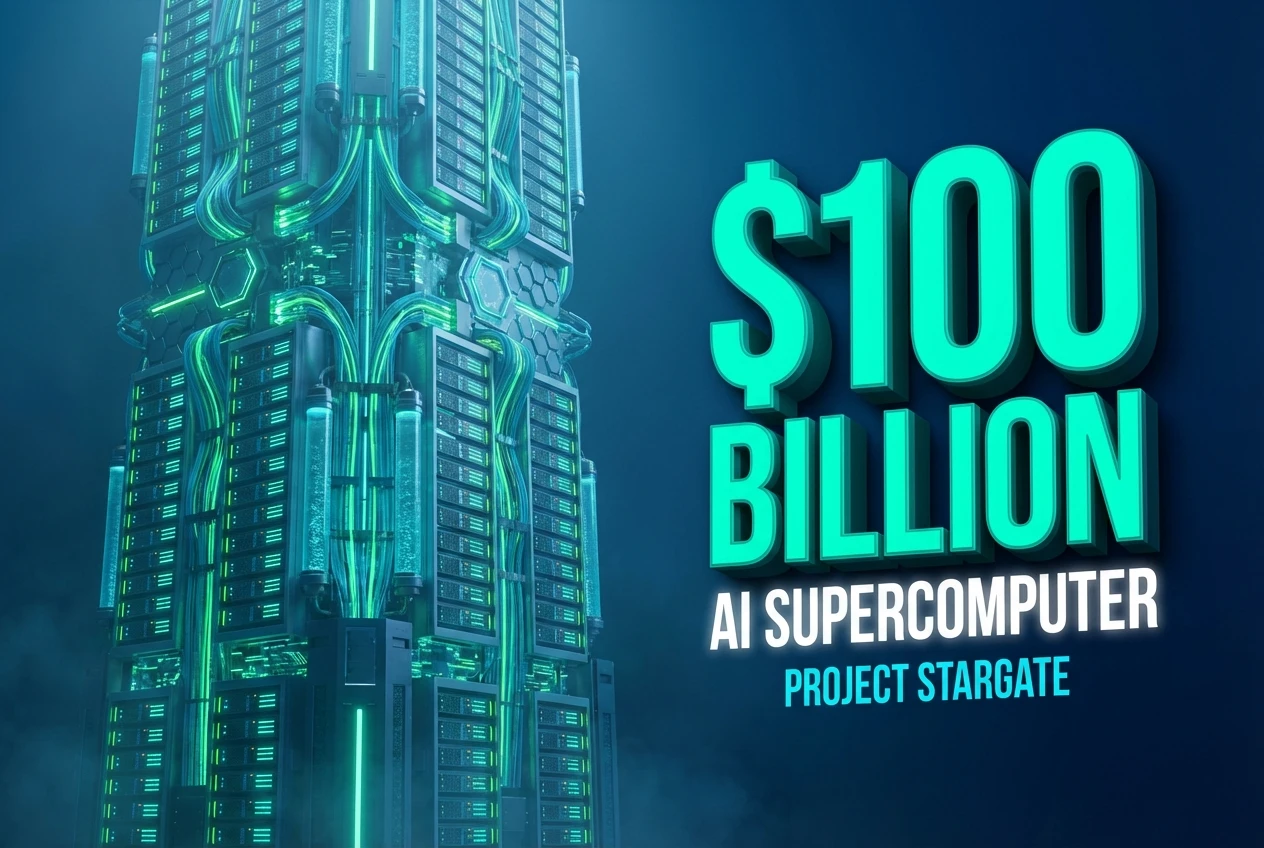
Building a top-tier data center right now usually costs around one billion dollars. Microsoft and OpenAI are currently drawing up blueprints to spend one hundred times that amount on a single computational facility. This project is not just a standard upgrade to existing cloud servers, but a fundamental shift in how the tech industry approaches artificial intelligence hardware.
A Five Phase Blueprint Ending in 2028
The timeline for this operation stretches across the remainder of the decade. According to early reports from The Information in March 2024, the initiative is expected to cost up to $100 billion, with Microsoft footing the vast majority of the bill. The tech giant has already poured over $13 billion into OpenAI since 2019, successfully constructing several smaller supercomputers used to train models like GPT-4. This new endeavor makes those previous investments look like practice runs.
Internal roadmaps reveal that the construction is split into five distinct steps. The Stargate supercomputer represents the fifth and final phase of the project, functioning as the ultimate goal of the current partnership. The two companies are targeting a launch date for this flagship facility, launching as early as 2028, though hardware delays could push that timeline further out.
Microsoft executives remain tight-lipped about the exact physical location, but they are clearly preparing investors for the capital expenditure. Frank Shaw, Chief Communications Officer at Microsoft, recently noted that the company is always planning for the next generation of infrastructure innovations needed to continue pushing the frontier of artificial intelligence capability. That preparation involves securing land, negotiating with local governments, and laying down fiber optic cables years in advance.
The Five Gigawatt Energy Problem
Money is only one part of the equation when building the largest computer on earth. The physical reality of turning the machines on presents a much harder barrier. Industry analysts estimate that a fully operational Stargate facility will require up to 5 gigawatts of power. To put that number into perspective, it is roughly equivalent to the energy needed to power several large cities simultaneously.
| Project Metric | Stargate Estimate | Current Industry Standard |
|---|---|---|
| Total Cost | $100 billion | $1 billion |
| Power Requirement | 5 Gigawatts | 50 to 100 Megawatts |
| Target Launch | 2028 | 12 to 24 months |
The International Energy Agency reported in early 2024 that global data center energy consumption could double by 2026, driven entirely by artificial intelligence operations and cryptocurrency mining. Finding a region with 5 gigawatts of surplus grid capacity is virtually impossible under current utility frameworks. This bottleneck has forced project leaders to explore alternative energy solutions.
Microsoft has the scale, the balance sheet, and the vision to pull this off, but the power requirements are the biggest hurdle.
Dan Ives, a Senior Equity Analyst at Wedbush Securities, highlighted this exact tension in a recent CNBC interview. The power dilemma is so significant that the United States Department of Energy has released policy reports regarding grid capacity and the potential use of small modular nuclear reactors to meet these unprecedented demands. If Microsoft wants to run Stargate, they may have to help build the power plants that feed it.
Custom Silicon and Federal Export Controls
A supercomputer is only as fast as the processors stacked inside its server racks. The Stargate blueprint calls for millions of specialized AI chips working in tandem. Procuring that volume of silicon requires more than just a blank check; it demands a total restructuring of the hardware supply chain.
Microsoft and OpenAI are evaluating several paths for outfitting the facility. They cannot rely on a single vendor to produce millions of high-end graphics processing units without facing severe delays. The current strategy involves diversifying the hardware sources while keeping the software ecosystem unified.
The hardware acquisition plan includes a few primary options:
- Purchasing next-generation NVIDIA accelerators in bulk
- Deploying custom silicon engineered entirely in-house by Microsoft
- Utilizing specialized networking equipment to connect chips from different manufacturers
This massive hardware order also attracts government scrutiny. The United States Department of Commerce is actively reviewing AI hardware export controls and regulatory guidelines. While Stargate is presumed to be built domestically, the global supply chain for raw materials, manufacturing, and assembly means that federal policy will directly impact the project’s construction schedule. Any restriction on component imports could stall the 2028 target date.
The Thirty Billion Dollar Infrastructure Fund
To lay the groundwork for a project of this magnitude, Microsoft is pulling in outside financial heavyweights. In September 2024, the company announced a $30 billion artificial intelligence infrastructure fund in partnership with BlackRock. This initiative, officially named the Global AI Infrastructure Investment Partnership, is designed to support the exact type of energy and data center projects that Stargate requires.
The creation of this fund signals that the tech industry can no longer finance the future of computing out of standard operational budgets. The infrastructure needs have grown too large. Gartner recently released a forecast indicating that hyperscale cloud spending is expected to grow by 20 percent annually through 2028. That growth is not driven by regular consumer web hosting, but by the relentless computational appetite of large language models.
The BlackRock partnership serves multiple strategic purposes for the Stargate timeline:
- Securing capital for localized power grid upgrades
- Funding the construction of advanced cooling systems for high-density server racks
- Creating a financial buffer against supply chain price fluctuations
- Pooling resources with energy experts to navigate Department of Energy regulations
OpenAI CEO Sam Altman has been traveling to industry forums throughout 2024 with a consistent message. He has repeatedly warned that the infrastructure needs of artificial intelligence are going to be a huge part of the story of the next decade. The BlackRock fund is the first tangible proof that traditional finance firms agree with his assessment.
As the groundwork for this hundred billion dollar facility begins, the focus shifts entirely from software algorithms to concrete, steel, and electricity. The race to build the ultimate #AISupercomputer isn’t just about who has the smartest engineers anymore. It is about who can physically source the power and hardware to turn the machines on, making the #OpenAI partnership a defining force in global infrastructure for years to come.